

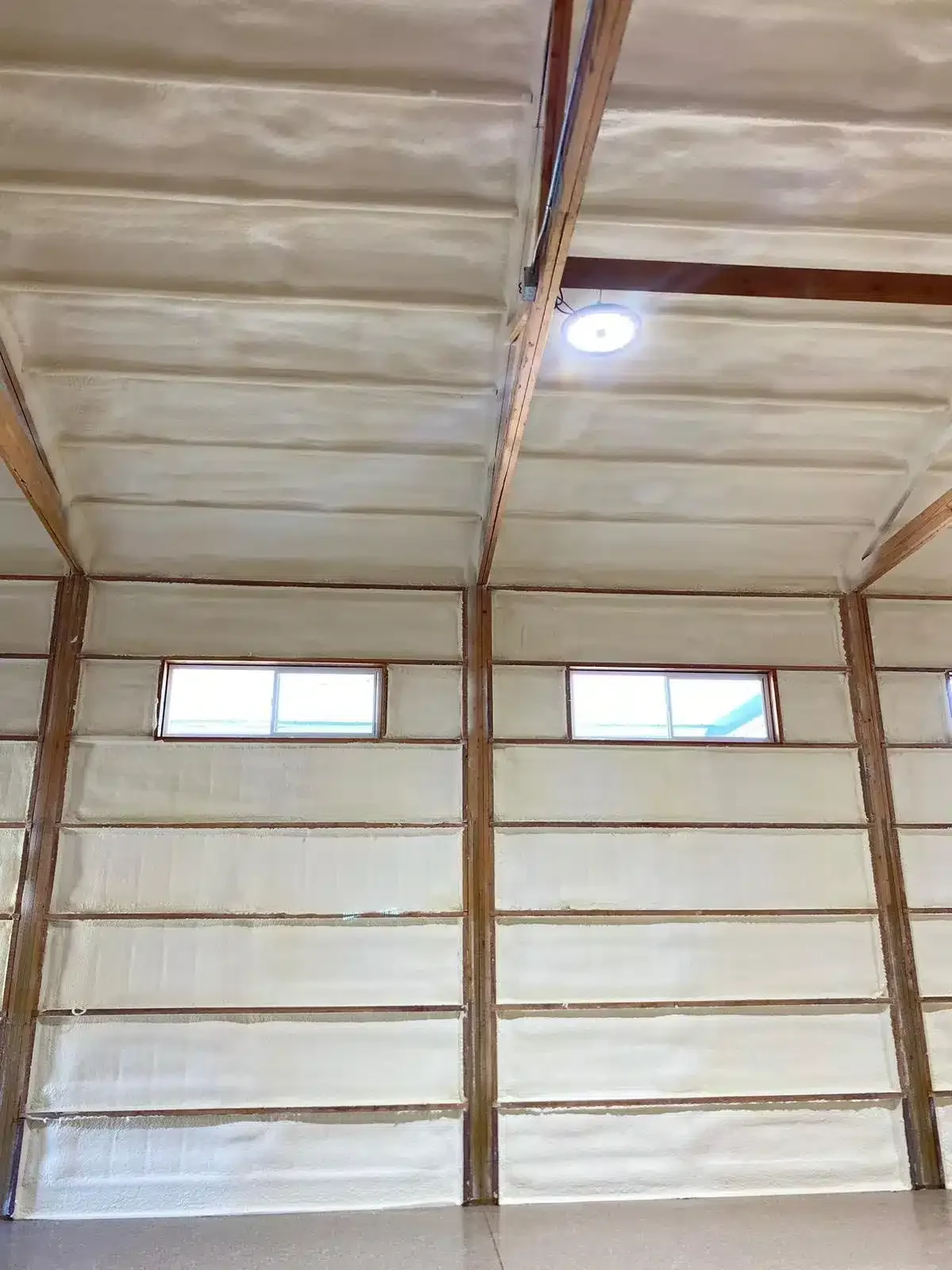
Selkirk Energy Solutions is a local pole barn insulation contractor serving Bonners Ferry, ID. We provide pole barn insulation services for workshops, storage buildings, and agricultural structures. We work with insulation options such as closed-cell spray foam and fiberglass to help reduce heat transfer and make these buildings more comfortable and practical to use.
The right insulation depends on your building's construction, how you use the space, and whether you're dealing with air leaks or condensation. We look at those factors before recommending an insulation approach.
Walls and ceilings: Both areas need attention because heat moves through the building envelope.
Material choice: Closed-cell spray foam and fiberglass have different installation and moisture-control requirements.
Existing buildings: Pole barn insulation retrofits need an assessment of current conditions.
Condensation: Insulation can be part of the solution, but air sealing, ventilation, and moisture sources also matter.
A pole barn used for equipment storage has different insulation needs from a workshop that's heated throughout the winter. The first step is deciding how you want the building to function.
Insulation slows heat movement through walls and roof assemblies. In a heated workshop, that can help maintain indoor temperatures and reduce the load on heating equipment. For an unheated storage building, insulation may help moderate temperature changes, but it won't maintain a set indoor temperature without a heat source.
Bonners Ferry's cold winters make insulation worth considering for buildings used regularly during colder months. The goal isn't simply to fill every cavity. It's to choose an assembly that works with the building's framing, exterior materials, and moisture conditions.
Good insulation planning can also help avoid gaps, compressed materials, and poorly sealed connections that reduce performance.
Pole barns often have metal roofing or siding attached to post-frame construction. Their wall and roof details affect where insulation belongs and how it should be installed.
We assess wall framing, cavity depth, and the interior finish before discussing insulation materials.
Pole barn wall insulation helps limit heat transfer through the sides of the building. Areas around doors, framing connections, and other openings also deserve attention because insulation doesn't automatically stop air leakage.
Ceiling and roof insulation serve different building designs.
A pole barn with a separate ceiling may have room for insulation above that ceiling. A building with exposed roof framing may need a roofline insulation approach instead.
Before choosing either option, we consider the roof assembly, available space, and ventilation requirements. Covering an existing moisture problem with insulation isn't a repair.
Existing pole barns can often be insulated, but their condition matters.
We look at accessible cavities, existing insulation, interior finishes, and signs of moisture before planning a retrofit. Buildings with exposed framing may allow different installation methods than barns with finished walls and ceilings.
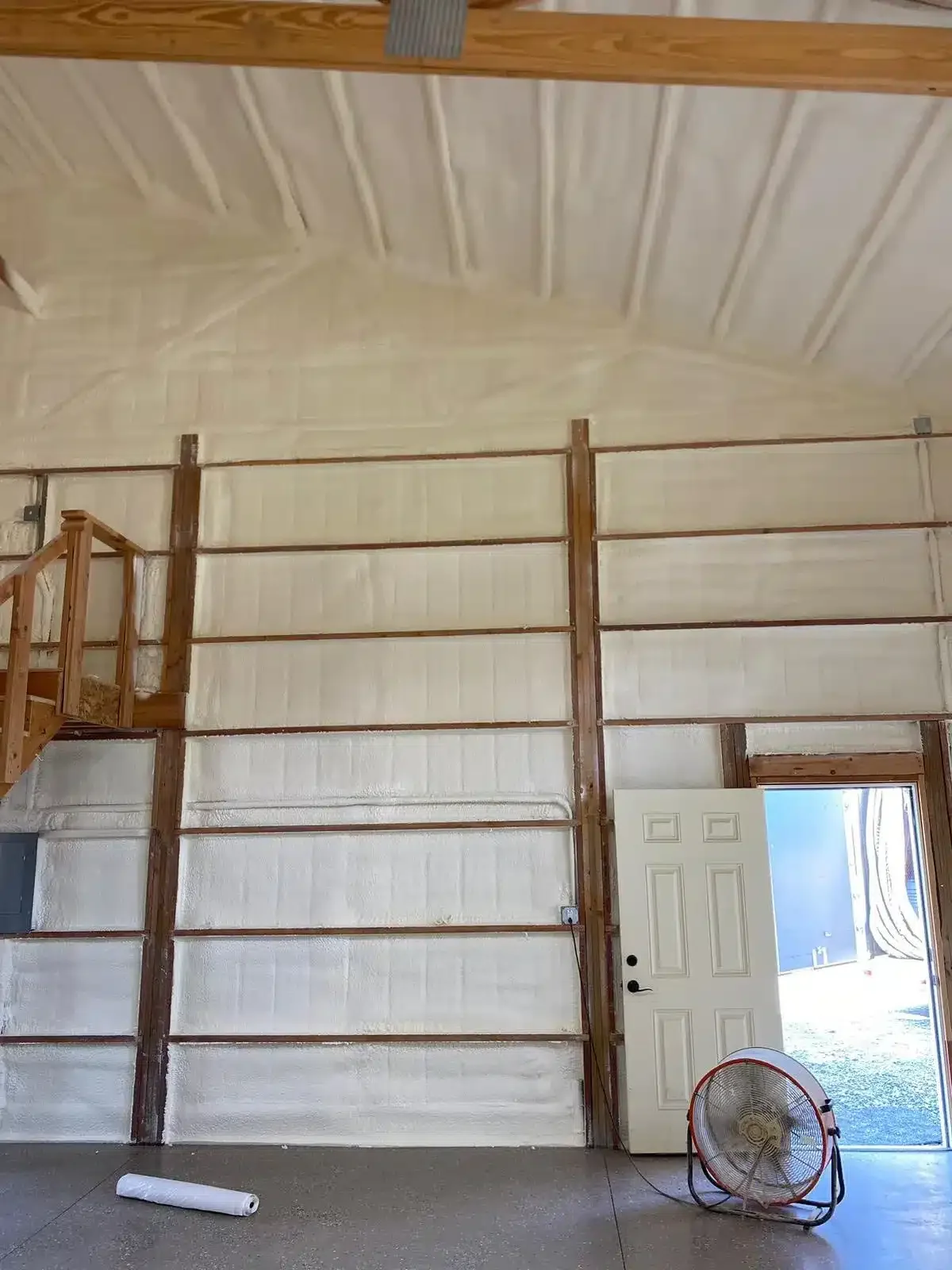
Closed-cell spray foam and fiberglass batts can both insulate pole barns. They don't perform the same way, though, and neither material is the best answer for every building.
Pole barn spray foam insulation expands after application and forms a rigid insulation layer. When properly installed, it can reduce heat transfer and unwanted air movement.
Its relatively high thermal resistance per inch can be useful where installation depth is limited. It also resists vapor movement, but the appropriate thickness and assembly design depend on the application.
Spray foam requires suitable substrate conditions, professional installation practices, and attention to applicable fire-protection requirements.
Fiberglass batts fit into appropriately sized framing cavities. They're an option for pole barns with suitable wall or ceiling assemblies.
Fiberglass insulation doesn't create an air seal by itself. Gaps, compression, and poor fitting around framing can reduce its effective performance. Moisture and vapor control must also be addressed separately where needed.
Factor | Closed-Cell Spray Foam | Fiberglass Batts |
Air sealing | Can form an air barrier | Needs separate air sealing |
Installation | Applied using specialized equipment | Fitted into framing cavities |
Moisture considerations | Resists vapor movement | Requires appropriate assembly detailing |
Cost | Generally higher material and installation cost | Often lower initial material cost |
Best fit | Depends on substrate, depth, and building design | Depends on framing and cavity access |
The U.S. Department of Energy explains that insulation materials differ in how they're installed and how they resist heat flow.
We recommend comparing the complete insulation assembly rather than choosing a material based only on price or advertised R-value.
Condensation forms when moist air contacts a surface cold enough for water vapor to turn into liquid. Metal roofing and siding can be especially noticeable places for this to occur.
Effective pole barn condensation control starts with understanding how moisture enters the building. Insulation may help manage surface temperatures, while air sealing can reduce the movement of moist indoor air into colder parts of the assembly. Neither measure eliminates every moisture source.
The U.S. Department of Energy's insulation guidance addresses the relationship between insulation, air leakage, and moisture control.
Before installing insulation, check for roof leaks, damp materials, and existing condensation. Also consider how moisture enters the building through wet equipment, ground conditions, or everyday activities.
A moisture-control plan may involve insulation, air sealing, ventilation, and other building details. The right combination depends on the structure.
We start by looking at the building rather than assuming every pole barn needs the same insulation.
Review the building: We consider its size, framing, wall and roof construction, current condition, and intended use.
Discuss insulation options: We compare suitable materials, insulation locations, and any preparation work the building may need.
Prepare for installation: Surfaces and work areas must meet the selected product's requirements. Existing leaks or moisture problems should be addressed first.
Install and inspect: The insulation must be installed according to the product specifications, with attention to coverage, gaps, and required safety measures.
For spray foam projects, the U.S. Environmental Protection Agency recommends checking surface conditions, controlling the work area, using appropriate protective equipment, and following product-specific ventilation and re-entry guidance.
Selkirk Energy Solutions helps property owners evaluate insulation options for pole barns, workshops, storage buildings, and agricultural structures.
If you're planning a new installation or upgrading an existing building, tell us how you use the space and what problems you're trying to solve. We can discuss suitable insulation options and the next steps for your project.
Call: (208) 295-9780 Email: [email protected]
Yes. Many existing pole barns can be insulated. Material selection depends on framing, accessible cavities, interior finishes, and any existing moisture problems.
Not always. Spray foam offers air-sealing benefits, while fiberglass can suit framed cavities. Building design, moisture control, and budget influence the choice.
It depends on your building's use and construction. A complete insulation plan should consider both areas, along with air leakage and heating needs.
Insulation may help control condensation, but it cannot fix roof leaks or every moisture problem. Air sealing, ventilation, and moisture sources also need consideration.
Not necessarily. Insulation may moderate temperature changes, but its value depends on what you're storing, how you use the building, and your goals.