How Can Spray Foam Insulation Help Reduce Persistent Drafts in Garwood, ID Homes?
Spray foam insulation reduces persistent drafts because it works as an insulation and an air barrier in a single application.…


Living in Boundary County, you know the winters here are no joke. January highs hover around 31°F and nighttime lows regularly plunge to 15°F or below. When that kind of cold presses against your home or commercial building for months on end, the quality of your insulation is not a luxury; it is a necessity. Poor insulation means wasted energy, drafty rooms, and higher utility bills that eat into your budget season after season.
Open-cell spray foam insulation has become one of the most effective ways to seal and insulate buildings, and for good reason. Unlike traditional batt insulation that gets stuffed between studs and leaves gaps around every pipe, wire, and framing member, spray foam expands into every crack and void, creating a continuous air barrier. The Department of Energy notes that air sealing is one of the most cost-effective ways to reduce heating and cooling costs, improve indoor comfort, and increase building durability. For a heating-dominated climate like ours in Bonners Ferry, that matters a great deal.
This guide is the product of years of hands-on experience insulating homes, agricultural buildings, and commercial structures across Boundary County and the surrounding areas. We have seen what works, what fails, and what makes the real difference in comfort and energy performance. By the end of this guide, you will understand exactly what open-cell spray foam is, how it works, where it belongs in a building, what to avoid, and how to decide if it is the right choice for your property.
Open-cell spray foam insulation is a type of polyurethane foam that is sprayed as a liquid and expands rapidly to fill cavities, cracks, and voids in a building’s framing. Once applied, it cures into a soft, spongy material with a three-dimensional matrix of interconnected open cells. The “open cell” part of the name refers to the fact that the tiny air bubbles within the foam are not sealed off from one another; they are interconnected, like a microscopic sponge.
According to the Department of Energy’s Building America research, open-cell spray foam consists of two liquid chemical components that are mixed at the spray gun nozzle. Side A contains polymeric MDI (methylene diphenyl diisocyanate), while Side B is a blend of polyol resins, surfactants, fire retardants, and catalysts. The key difference from closed-cell foam is the blowing agent. Open-cell foam primarily uses water as the blowing agent, which generates carbon dioxide during the reaction and causes the foam to expand dramatically, roughly 150 times its original volume. Closed-cell foam uses hydrofluorocarbons (HFCs) and expands only 35 to 50 times its original volume.
The resulting material is lightweight, weighing approximately 0.5 pounds per cubic foot. It is soft enough to be compressed by hand and stays somewhat flexible after curing, which allows it to accommodate minor building movement without cracking or losing its seal. This flexibility is one of its practical advantages in wood-frame construction, where seasonal expansion and contraction are a fact of life.
A typical 5.5-inch wall cavity filled with open-cell spray foam delivers roughly R-20 of insulation while simultaneously sealing every gap, penetration, and irregular surface that traditional insulation materials simply cannot reach. That combination of thermal resistance and air sealing is what makes this material so effective.
Understanding the differences between the two main types of spray foam helps you make informed decisions. Here is a side-by-side look at how they compare:
| Property | Open Cell Spray Foam | Closed Cell Spray Foam |
|---|---|---|
| Density | ~0.5 lb/cubic foot | ~2.0 lb/cubic foot |
| R-Value per inch | R-3.5 to R-3.8 | R-6.0 to R-7.0 |
| Expansion ratio | Up to 150x liquid volume | 35 to 50x liquid volume |
| Vapor permeability | Vapor permeable (5-10 perms at 5 inches) | Vapor barrier (less than 1 perm at 2 inches) |
| Air barrier | Yes, at 3.5 inches in thickness | Yes, at 1 inch thickness |
| Water absorption | Can absorb and hold liquid water | Hydrophobic, does not absorb water |
| Sound damping | Excellent (STC 23, NRC 70) | Moderate |
| Rigidity | Soft and flexible | Hard and rigid |
| Structural reinforcement | None | Adds racking strength |
| Cost per square foot | Lower | Higher |
The science behind spray foam insulation is straightforward once you understand the basics. When the two liquid components meet at the spray gun tip, a chemical reaction begins almost instantly. The mixture hits the target surface as a liquid and begins expanding within seconds. The reaction generates heat, and the carbon dioxide gas from the water-based blowing agent creates millions of tiny bubbles throughout the material.
For open cell foam, the cell walls between these bubbles are thin enough that they rupture during expansion, leaving behind only the structural struts where bubbles once touched. This creates the interconnected network of open cells that gives the material its name. The foam continues to expand and cure over several minutes, reaching its final volume before hardening into its permanent form.
The insulation value comes from two mechanisms working together. First, the trapped air within the cell matrix resists conductive heat transfer. Second, and arguably more important, the foam completely fills the cavity and seals it against air movement. Air leaks are responsible for a significant portion of energy loss in most buildings. When open cell spray foam fills a wall cavity, it eliminates the drafts, convective loops, and random air pathways that traditional batt insulation leaves behind.
The foam cures fully within 24 hours under normal conditions, though it can be trimmed back or covered much sooner depending on the specific product and application requirements. Once cured, it remains stable and does not settle, sag, or degrade over time, which is a meaningful advantage over loose-fill insulation that can compact in wall cavities over the years.
Key Takeaways:
R-value is the standard measure of how well an insulation material resists heat flow. The higher the R-value, the better the thermal performance. Open cell spray foam delivers approximately R-3.6 per inch of thickness, according to Building America research data. While that is lower per inch than closed cell foam, open cell foam’s lower cost per volume often makes it possible to fill entire cavities to greater depth, achieving competitive total R-values at a lower price point.
Bonners Ferry falls in IECC Climate Zone 6, one of the colder regions in the continental United States. The ENERGY STAR recommended R-values for Climate Zone 6 are:
| Building Component | Minimum R-Value for Zone 6 |
|---|---|
| Attic (uninsulated) | R-60 |
| Attic (existing 3-4 inches) | R-49 |
| Wood frame wall | R-20 + R-5 continuous insulation, or R-13 + R-10 CI, or R-0 + R-20 CI |
| Floor over unconditioned space | R-30 |
| Basement/crawlspace wall | R-15 insulative sheathing or R-19 batt |
A standard 2×6 wall cavity (5.5 inches deep) filled with open-cell spray foam at R-3.6 per inch delivers approximately R-20. In many cases, that meets or comes close to the cavity fill portion of the code requirement, and adding R-5 continuous exterior insulation during a re-siding project would bring the full assembly into compliance.
For attics, achieving R-60 with open-cell foam alone would require about 16.7 inches of thickness, which is often impractical in existing homes with standard rafter depths. In new construction, deeper roof framing can accommodate that thickness. In retrofit situations, a common approach is to use open-cell foam on the underside of the roof deck to create a sealed, unvented attic assembly combined with additional insulation strategies.
Expert Tip: In our experience working in Boundary County, we often recommend a hybrid approach for attics. Open cell foam applied to the roofline at 5.5 to 7 inches creates the airtight seal, while additional insulation strategies address the remaining R-value requirement. This gives you the air sealing benefits without the cost of filling the entire rafter bay with foam.
Not every location in a building is a good candidate for open-cell spray foam. Understanding where it excels and where it should be avoided is essential for a successful project.
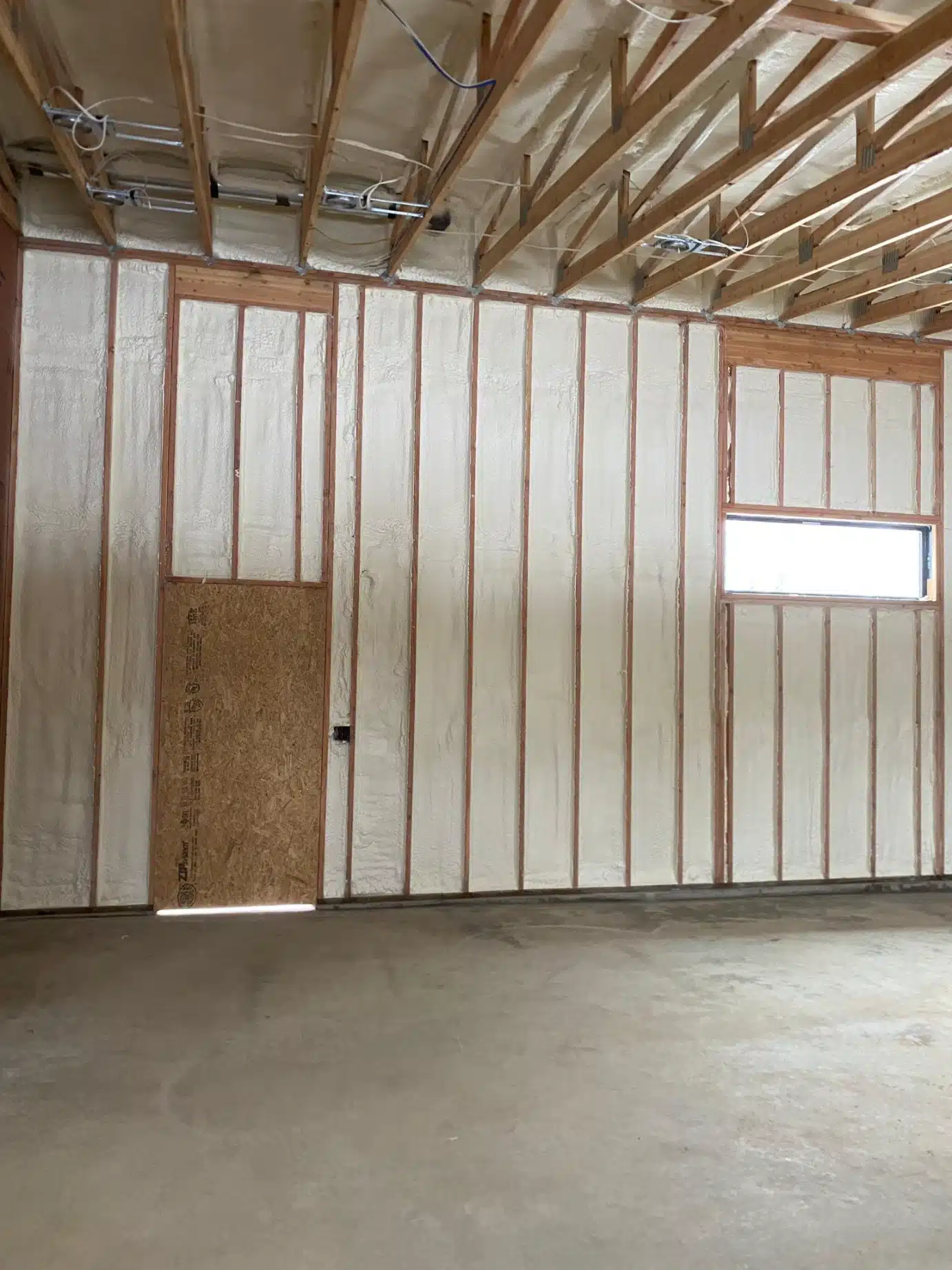
Wall Cavities (Cold Climates): Open-cell spray foam is rated as “preferred” for frame wall cavities in cold climates by Building America researchers. When applied to full cavity depth, it delivers roughly R-20 in a standard 2×6 wall, provides an airtight seal, and allows the wall assembly to dry to the exterior if moisture does get in. This vapor permeability is actually an advantage in cold climates because it prevents trapped moisture from causing rot or mold behind the drywall.
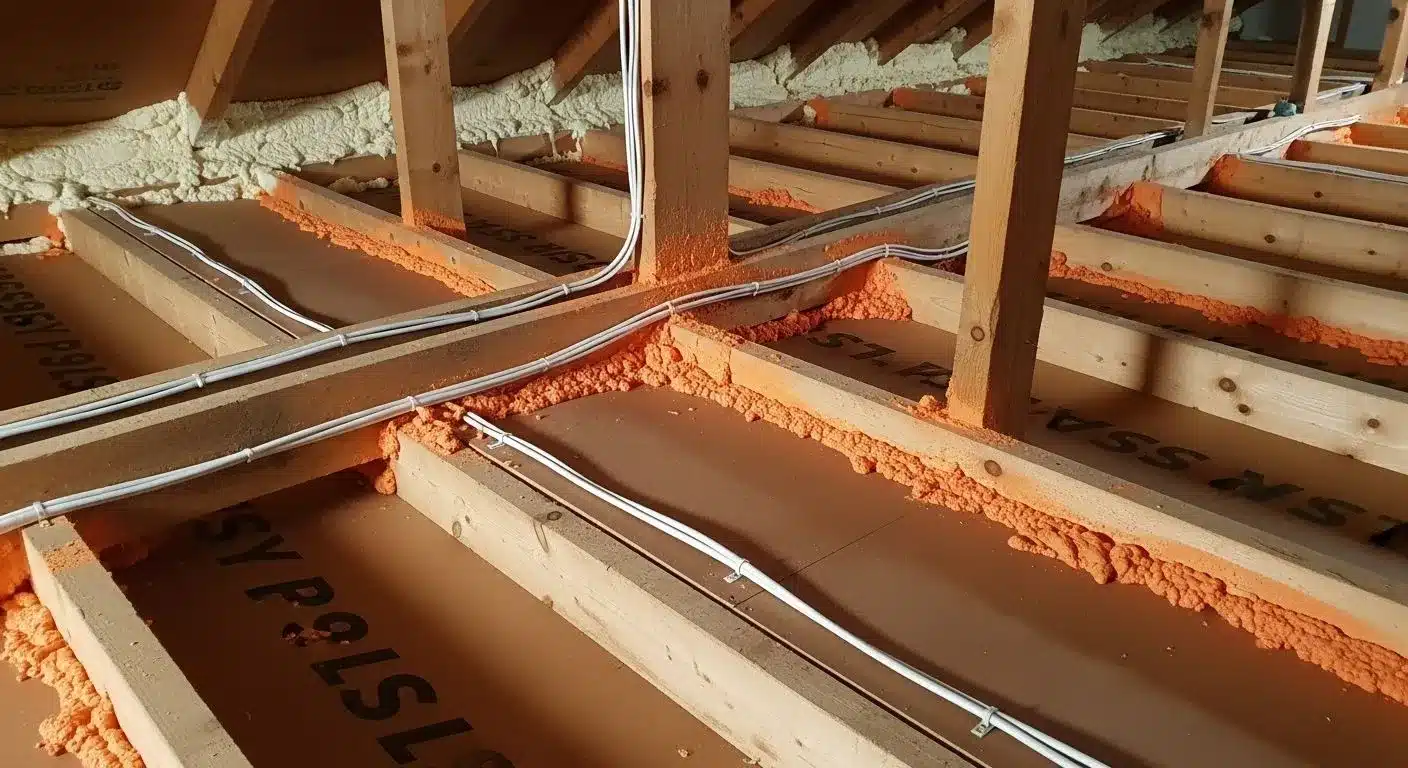
Sloped Roof Rafters: Open-cell foam applied directly to the underside of the roof deck is an acceptable application in cold climates. It seals the attic plane, prevents ice dam-related air leaks, and brings ductwork and mechanical systems inside the conditioned envelope. At typical thicknesses of 5.5 to 7 inches, it provides a solid air seal and meaningful R-value, though supplementary insulation may be needed to reach R-60.
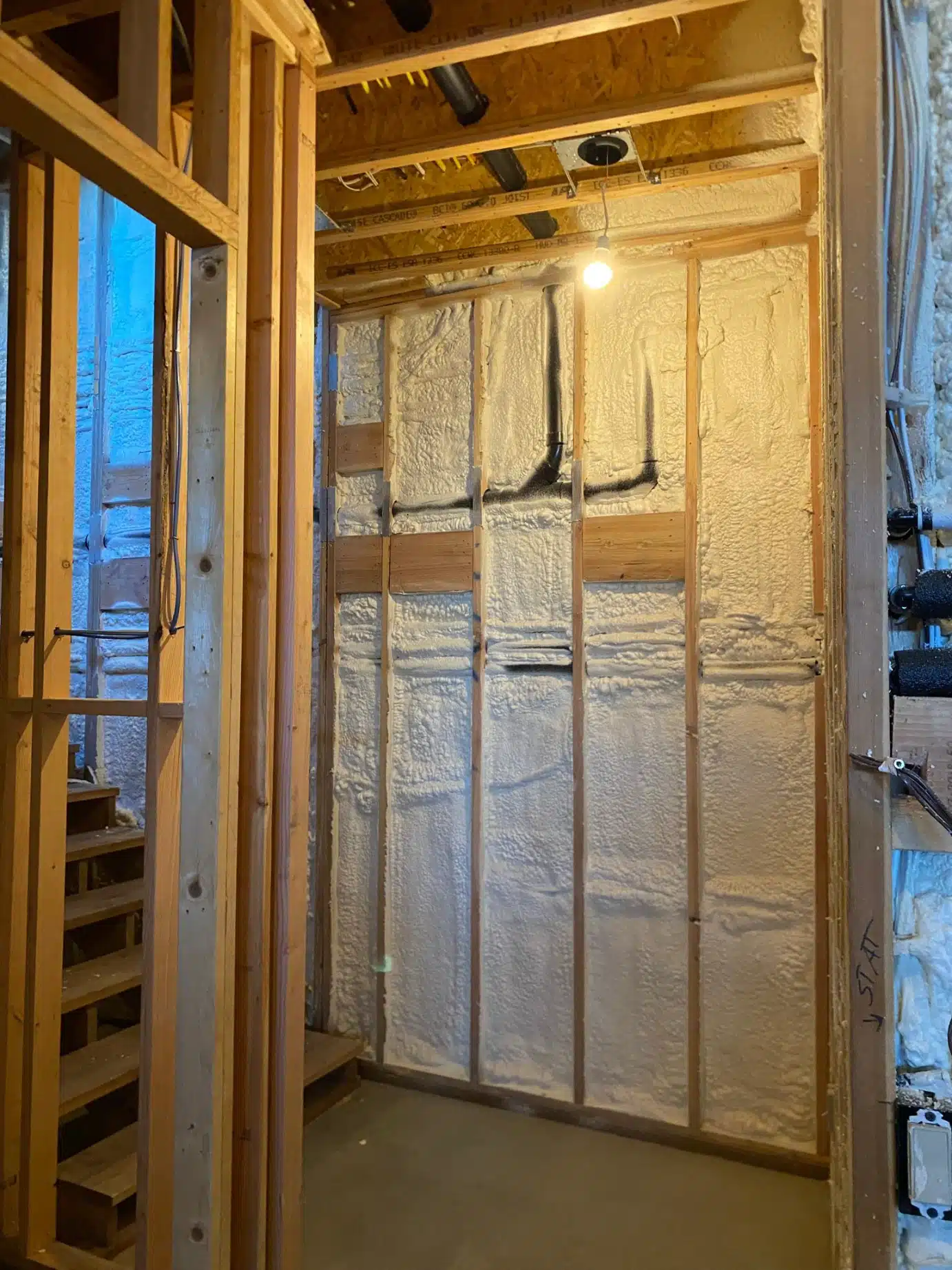
Band Joists and Rim Joists: These perimeter areas, where floor framing meets exterior walls, are notoriously difficult to insulate with batts. Open-cell foam fills these irregular, hard-to-reach spaces, sealing the gap between floors. Because band joists are concealed within the floor assembly, no additional thermal barrier is required.
Cantilevered Floors and Floors Over Unconditioned Space: Open-cell foam works well in these locations because it provides both insulation and air sealing in a single application. It fills around plumbing, wiring, and ductwork that passes through these areas.
Sound Control Applications: With a Noise Reduction Coefficient (NRC) of 70 and a Sound Transmission Class (STC) of 23 in a standard 2×4 wall assembly, open cell foam significantly outperforms rigid closed cell foam and traditional batt insulation for sound damping. Interior partition walls between bedrooms, home offices, and living spaces benefit greatly from this acoustic performance.
Below-Grade Spaces: Open-cell foam is not appropriate for basement walls, crawl space foundation walls, or any below-grade application. The Building America guide classifies this as “not acceptable” because the foam can absorb and hold liquid water from ground moisture, leading to water damage and potential mold issues.
Exterior Continuous Insulation: Open cell foam should not be used as exterior continuous insulation because it is permeable to moisture and does not shed water. Continuous exterior insulation requires closed cell foam or rigid board products.
HVAC Duct Insulation: When ducts are located in unconditioned attic spaces, open cell foam should not be applied directly to the duct surface. The foam’s moisture permeability means condensation from humid attic air can penetrate and saturate the insulation, creating water damage risks.
Key Takeaways:
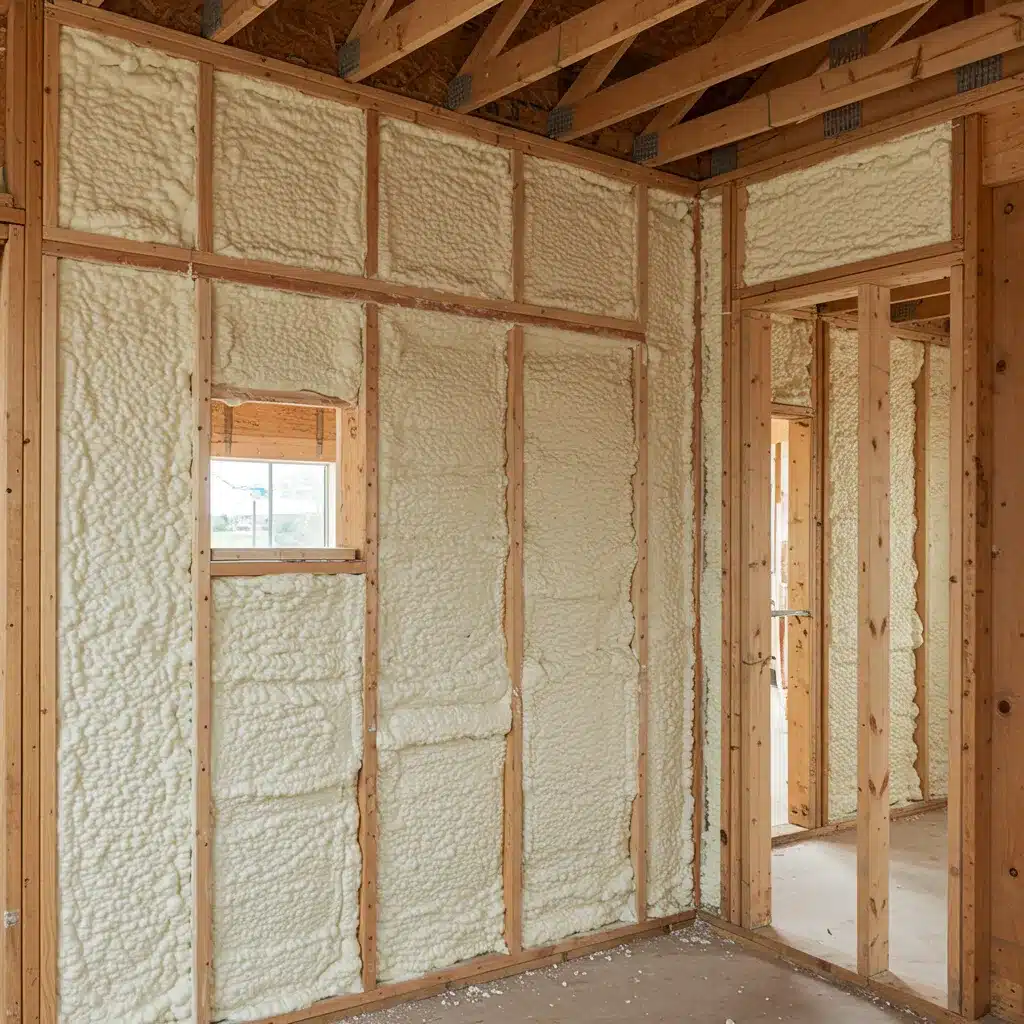
Understanding the installation process helps you prepare your property and know what to expect on project day. Here is the step-by-step progression of a typical open cell spray foam installation.
Before any foam is sprayed, the work area needs to be prepared. This includes:
The actual spray process uses specialized equipment consisting of a proportioner (which heats and pumps the two chemical components), heated hoses, and a spray gun. A trained two-person crew is standard: one person operates the spray gun while the other manages the proportioner and monitors material levels.
Open-cell foam can be applied to the full cavity depth in a single pass, generally up to about 10 inches of thickness. This is a practical advantage over closed-cell foam, which is limited to 2 to 3 inches per pass and requires multiple lifts to achieve greater thickness. The foam expands rapidly and reaches full volume within seconds, then cures over several minutes to hours.
The applicator works methodically across the framing cavities, maintaining consistent thickness and complete coverage. In retrofit applications where wall cavities are being filled from the interior, holes may be drilled through the drywall and the foam injected, or sections of drywall may be removed for direct access.
After the foam is sprayed:
Expert Tip: One of the most common issues we see on retrofit projects is homeowners who try to save money by leaving furniture in the room. Overspray from open-cell foam travels further than most people expect, and removing cured foam from furniture or finished surfaces is extremely difficult. Clear the area completely.
Understanding how open-cell spray foam interacts with moisture is one of the most important aspects of using it correctly, especially in a cold climate like Bonners Ferry, ID.
At a typical thickness of 5 inches, open-cell spray foam has a vapor permeance rating of 5 to 10 perms, depending on the specific product. For reference, a material needs a perm rating of 1.0 or less to be classified as a vapor retarder. This means open-cell foam is clearly vapor permeable, and moisture can pass through it in both directions.
This permeability has both advantages and risks. On the positive side, if a wall assembly gets wet from either interior or exterior moisture sources, the foam allows the assembly to dry out rather than trapping that moisture inside the cavity. In a cold climate where the primary moisture drive comes from the heated interior pushing outward, this drying capability is valuable for long-term building durability.
On the risk side, open-cell foam can absorb and hold liquid water. If there is a significant water leak or prolonged moisture exposure, the foam can become saturated. In extreme cases, it can hold up to one-third of its volume in water. While it will eventually dry, the process can be slow, and wet foam temporarily loses some of its insulating value.
In Bonners Ferry’s cold climate, the Building America guide emphasizes that interior air sealing and vapor control are critical when using open-cell foam in wall cavities. The recommended approach is to use vapor-retardant paint on the interior drywall surface, or standard latex paint applied in multiple coats. This creates a Class II or Class III vapor retarder on the warm side of the wall, slowing moisture movement into the cavity from the heated interior during winter.
On the exterior side, it is important to use a vapor-permeable sheathing and weather-resistive barrier (like standard housewrap) to allow the wall assembly to dry outward. Combining open-cell foam (permeable) on the interior with an impermeable exterior surface (like foil-faced sheathing or certain foam board products) creates a trapped moisture condition that has led to catastrophic building failures in documented cases.
For more information on managing moisture in building assemblies,
One area where open cell spray foam genuinely outperforms most other insulation materials is sound attenuation. The soft, open cell structure absorbs sound energy rather than reflecting it, making it highly effective at reducing noise transmission through walls and ceilings.
In a standard 2×4 wood stud wall assembly, open cell spray foam achieves a Sound Transmission Class (STC) rating of 23 and a Noise Reduction Coefficient (NRC) of 70. The NRC rating means the foam absorbs approximately 70% of the sound energy that reaches it. By comparison, fiberglass batt insulation typically provides lower NRC values and does not seal the small gaps and cracks that allow sound to flank around the insulation.
This makes open cell foam an excellent choice for:
The material is particularly effective at absorbing mid-to-high frequency sounds like voices, television audio, and general household noise. Low-frequency sounds like bass from music or mechanical equipment vibration are harder to address with any cavity-fill insulation alone and may require additional strategies.
Any honest conversation about spray foam insulation must include the health and safety aspects. Spray polyurethane foam involves chemicals that require careful handling during installation, and building occupants need to understand the re-entry and curing process.
The U.S. Environmental Protection Agency has documented health concerns related to spray polyurethane foam chemicals. The primary concern is exposure to isocyanates, the reactive chemicals in Side A of the foam formulation. According to the EPA, exposure to isocyanates may cause skin and eye irritation, asthma, lung damage, respiratory problems, and sensitization. Once a person becomes sensitized to isocyanates, even very low concentrations can trigger severe reactions, and there is no recognized safe exposure level for sensitized individuals.
The EPA notes that Side B contains a blend of chemicals that varies by manufacturer, including amine catalysts that can cause blurry vision, flame retardants that may be persistent or bioaccumulative, blowing agents with potential health effects, and surfactants that may be linked to endocrine disruption. These risks are primarily associated with installation-phase exposure, not with the fully cured material.
During installation, proper personal protective equipment, ventilation, and safe work practices are mandatory. The EPA strongly recommends that building occupants receive clear guidance from the contractor on safe re-entry times before the work begins. Once the foam has fully cured, typically within 24 to 72 hours, depending on product, thickness, and conditions, the cured material is considered inert and stable. The chemical reaction is complete, and no further off-gassing of the original components occurs under normal conditions.
That said, the EPA also warns that some advertising claims for spray foam products do not clearly indicate that they contain hazardous chemicals. Building owners should be aware that proper installation practices, protective equipment, and adequate ventilation are non-negotiable, regardless of how a product is marketed.
Both open and closed cell spray foams are combustible materials and are regulated under the International Residential Code Section R314 for foam plastic insulation. All spray foam products are formulated with fire retardants to reduce flame spread and smoke generation. Most spray foams achieve a flame spread index below 25 and a smoke developed index below 450 as measured by ASTM E84 testing.
In habitable spaces, spray foam must be covered by a 15-minute thermal barrier, which is most commonly half-inch gypsum board. This requirement ensures that if a fire occurs, the foam is protected from direct flame exposure long enough for occupants to evacuate safely.
Expert Tip: If you are considering spray foam for an attic space that you want to use for storage, be aware that the code distinction between “storage” and “utility access only” matters. An attic with storage requires a full thermal barrier (gypsum board), while a utility-only attic may qualify for an ignition barrier instead. Clarifying this with your installer and local code official before the project begins can save time and money.
Open-cell spray foam is not limited to residential applications. Commercial and agricultural buildings in the Bonners Ferry area benefit significantly from its air sealing and insulating properties.
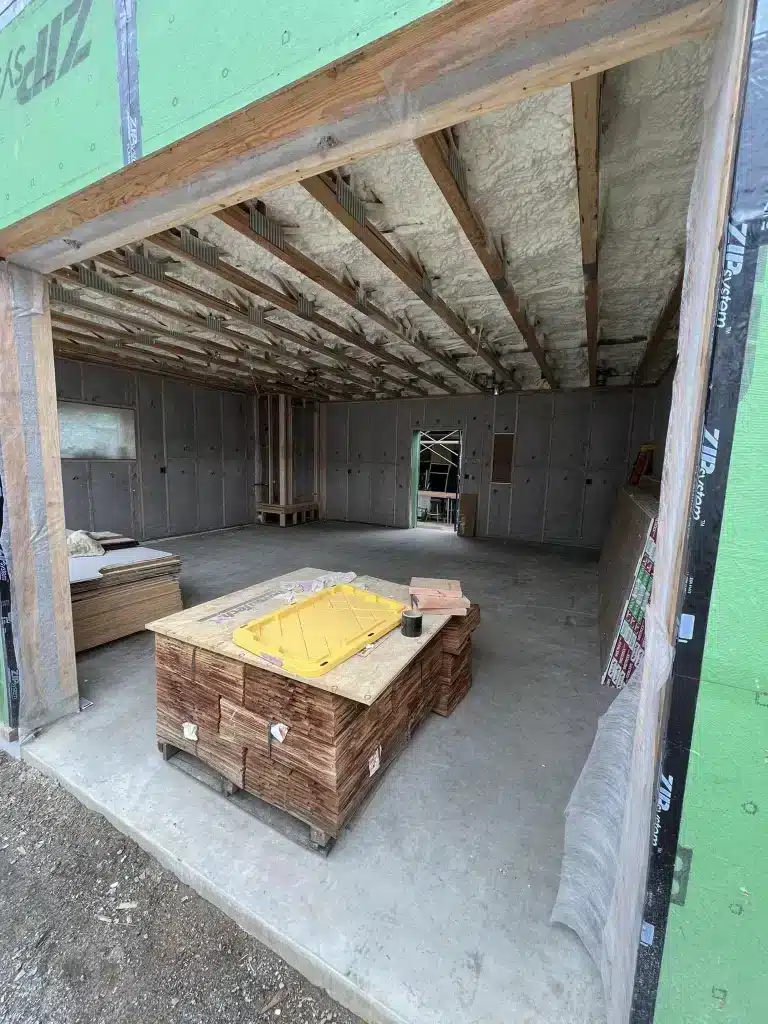
Agricultural Buildings: Metal pole barns and agricultural structures are common throughout Boundary County. Open-cell spray foam applied to the underside of metal roofing and between wall girts provides effective insulation while reducing condensation that can drip onto livestock, feed, and equipment. The air sealing prevents the massive heat loss that makes uninsulated metal buildings so expensive to heat during winter.
Office and Retail Spaces: For commercial buildings with metal stud or wood frame walls, open-cell foam fills the cavities completely and provides meaningful sound control between occupied spaces. The air sealing also contributes to more consistent indoor temperatures and lower HVAC operating costs.
Warehouses and Storage Buildings: In buildings where full climate control is not needed, open-cell foam still adds value by reducing condensation on metal roofing and walls, protecting stored goods from moisture damage. The improved air sealing means less heat loss in winter and lower cooling costs in summer for any climate-controlled zones within the building.
The choice between open-cell and closed-cell spray foam depends on the specific application, budget, and performance requirements. Here are the key decision factors:
Choose Open Cell When:
Choose Closed Cell When:
In practice, many well-designed building envelopes use both. A common and effective strategy is the “flash and batt” approach, where a thin layer of closed-cell foam is sprayed first as an air and vapor barrier, followed by either open-cell foam or fiberglass batts to fill the remaining cavity depth. This gives you the moisture control of closed cell with the cost efficiency of cavity fill insulation.
Over the years, we have seen projects go wrong when installers cut corners or when homeowners make decisions based on incomplete information. Here are the most common mistakes we encounter.
Skipping the Vapor Retarder on the Interior Side: In a cold climate, warm interior air carries moisture. If that moisture migrates through the drywall and into the open cell foam, the foam can become wet over time. Applying vapor-retardant paint to the interior drywall surface is a simple, inexpensive step that prevents this problem.
Using Open Cell Foam Below Grade: This mistake can cause serious water damage. Open cell foam absorbs and holds liquid water. If applied to basement walls or below-grade crawlspace surfaces, ground moisture will eventually saturate the foam, leading to mold, rot, and structural damage.
Combining Open Cell Foam with an Impermeable Exterior: If the exterior sheathing is impermeable (foil-faced foam board, some vinyl barriers, or certain stucco systems) and open cell foam is used in the cavity, moisture has nowhere to go. The wall assembly cannot dry in either direction, and moisture accumulation becomes likely. Always ensure at least one side of the assembly can dry.
Undercutting on Thickness: Spray foam only delivers its rated R-value at the correct thickness. If a contractor sprays only 3 inches of open cell foam in a 5.5-inch cavity, you get roughly R-10.8 instead of the R-19.8 you would get at full depth. The cost savings of spraying less foam are far outweighed by the permanent performance loss.
Ignoring Thermal Barrier Requirements: Leaving spray foam exposed in habitable spaces violates building code and creates a fire safety hazard. Half-inch gypsum board is the standard solution and should be planned into the project schedule and budget.
Expert Tip: If you are getting quotes from multiple installers, compare the proposed foam thickness and total R-value, not just the price per square foot. A lower quote that uses less material may cost you more in energy bills for as long as you own the building.
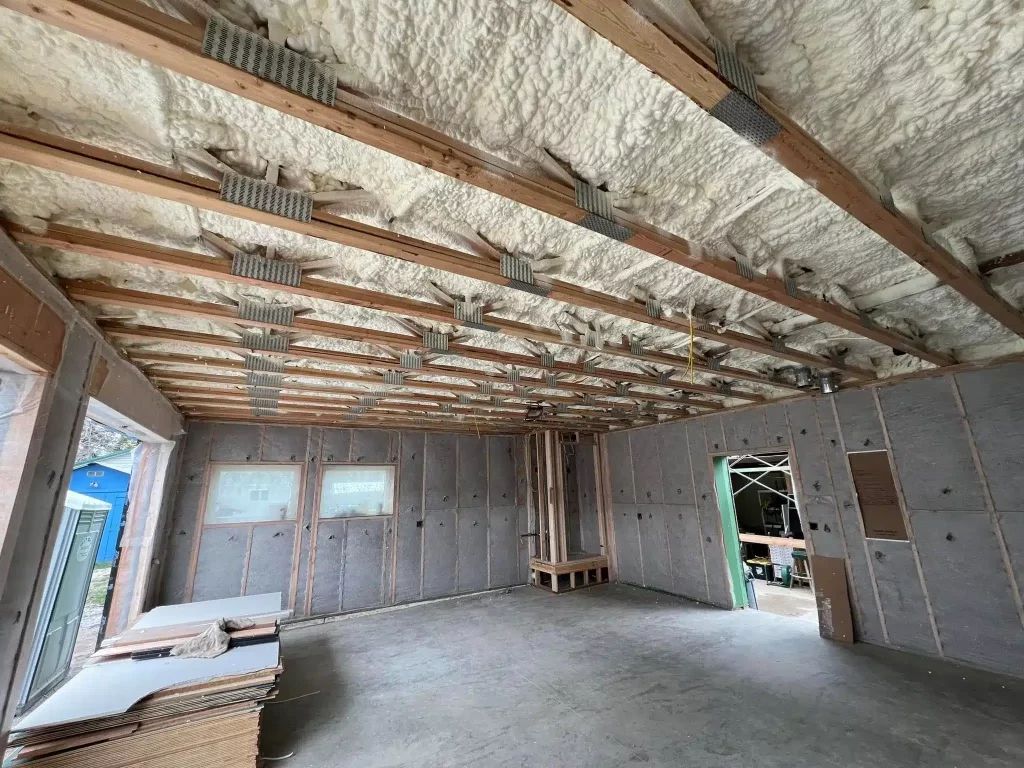
There is a financial incentive beyond energy savings for homeowners considering spray foam insulation. The federal government offers a tax credit for insulation and air sealing improvements that meet the 2021 International Energy Conservation Code (IECC) requirements.
The Energy-Efficient Home Improvement Credit, established under the Inflation Reduction Act, provides a tax credit of 30% of the cost of insulation materials and installation, up to $1,200 per year. The insulation must meet or exceed the IECC requirements for your climate zone, which means it must be part of a project that brings the building assembly up to the minimum R-values prescribed for Zone 6 in our area.
This credit applies to both existing homes and new construction. For homeowners in Bonners Ferry, insulating an uninsulated attic to R-60 or adding insulation to walls that currently fall below code are the types of improvements that qualify. Keep your receipts, manufacturer documentation showing the product’s R-value, and installation records for tax filing purposes.
In Boundary County, spray foam insulation installations in new construction and significant remodels are subject to the International Residential Code (IRC) and International Building Code (IBC). Key code requirements include:
Permits are typically required for insulation work that is part of new construction, additions, or remodels. Standalone insulation retrofit projects may or may not require permits depending on local jurisdictional interpretations. We always verify permit requirements with the local building department before beginning a project.
By now, you should have a clear picture of what open cell spray foam insulation is, how it performs in Bonners Ferry’s cold climate, where it belongs in your building, and what it takes to install it correctly. The material’s combination of air sealing, thermal resistance, sound damping, and vapor permeability makes it a strong choice for wall cavities, roof rafters, and band joists in above-grade applications throughout Boundary County.
The most important factors to get right are proper material selection for each application, correct foam thickness to meet R-value targets, appropriate vapor control strategies for cold climate assemblies, and working with an experienced installer who understands the specific challenges of our climate zone. Cutting corners on any of these points undermines the performance and durability of the entire insulation system.
Keep this guide as a reference as you plan your project. Use the comparison tables to evaluate quotes and proposals, and make sure any installer you hire can explain the moisture management strategy for your specific building assembly. An insulation investment that is done right pays dividends for decades. One that is done wrong can create problems that are expensive and difficult to fix.
If you are considering open cell spray foam insulation for your home or building in Bonners Ferry or anywhere in Boundary County, we are here to help. Selkirk Energy Solutions can evaluate your building, recommend the right insulation approach for each area, and provide a detailed proposal. Reach out to us at [email protected] or call (208) 295-9780 to schedule a consultation.
When properly installed, open-cell spray foam insulation lasts the lifetime of the building. The cured foam does not degrade, settle, or lose its R-value over time.
Yes, spray foam can be installed in cold weather, though ambient temperatures at the spray surface typically need to be above 40°F for proper curing. Heated enclosures and specialized cold-weather formulations may be used for winter installations.
No. Once cured, spray foam does not provide any food source for insects or rodents. Its sealed, continuous nature also eliminates the gaps and voids that pests use to travel through wall cavities.
For homes and buildings in Bonners Ferry’s cold climate, the combination of air sealing and insulation that spray foam provides delivers meaningful energy savings and comfort improvements that traditional insulation cannot match. The air sealing alone addresses one of the largest sources of energy waste in most buildings.
If a roof leak occurs above open-cell foam, water will penetrate the foam, and it will become saturated. The foam will eventually dry out once the leak is repaired, but this drying process can take time. Inspecting the roof condition before applying foam is important, especially on older buildings.
It can be removed, but the process is labor-intensive and messy. The foam must be cut and scraped from the framing surfaces. Removal is sometimes necessary when old foam has been damaged by water or when a building is being gutted for renovation.