How Can Spray Foam Insulation Help Reduce Persistent Drafts in Garwood, ID Homes?
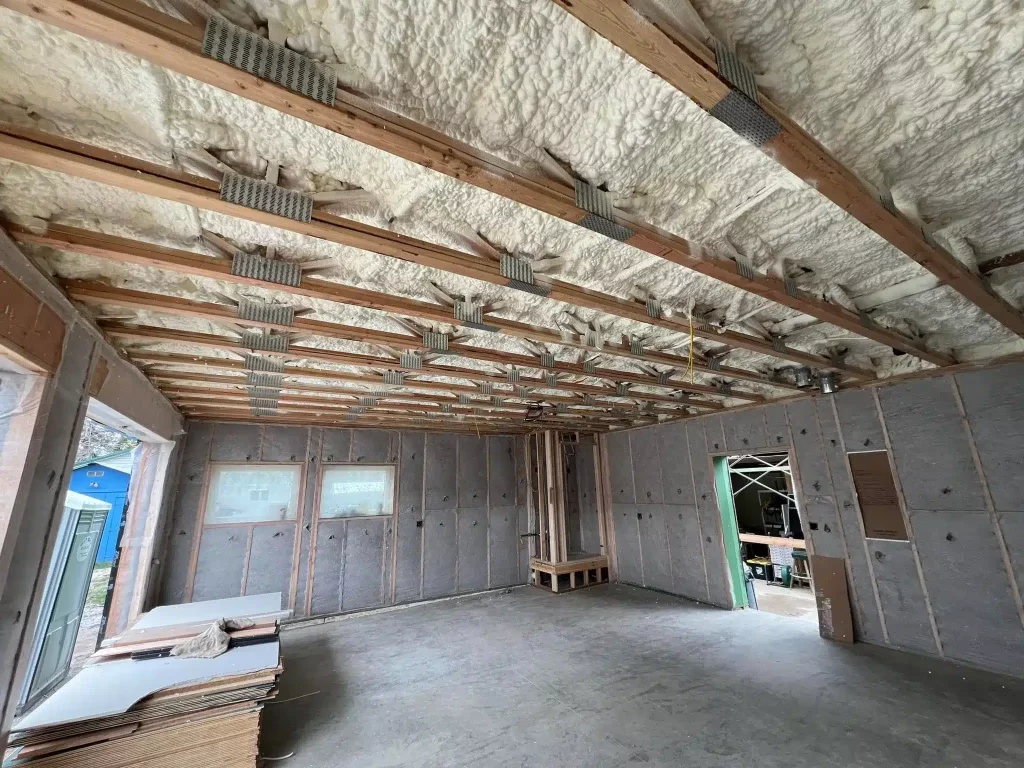
Spray foam insulation reduces persistent drafts because it works as an insulation and an air barrier in a single application.…


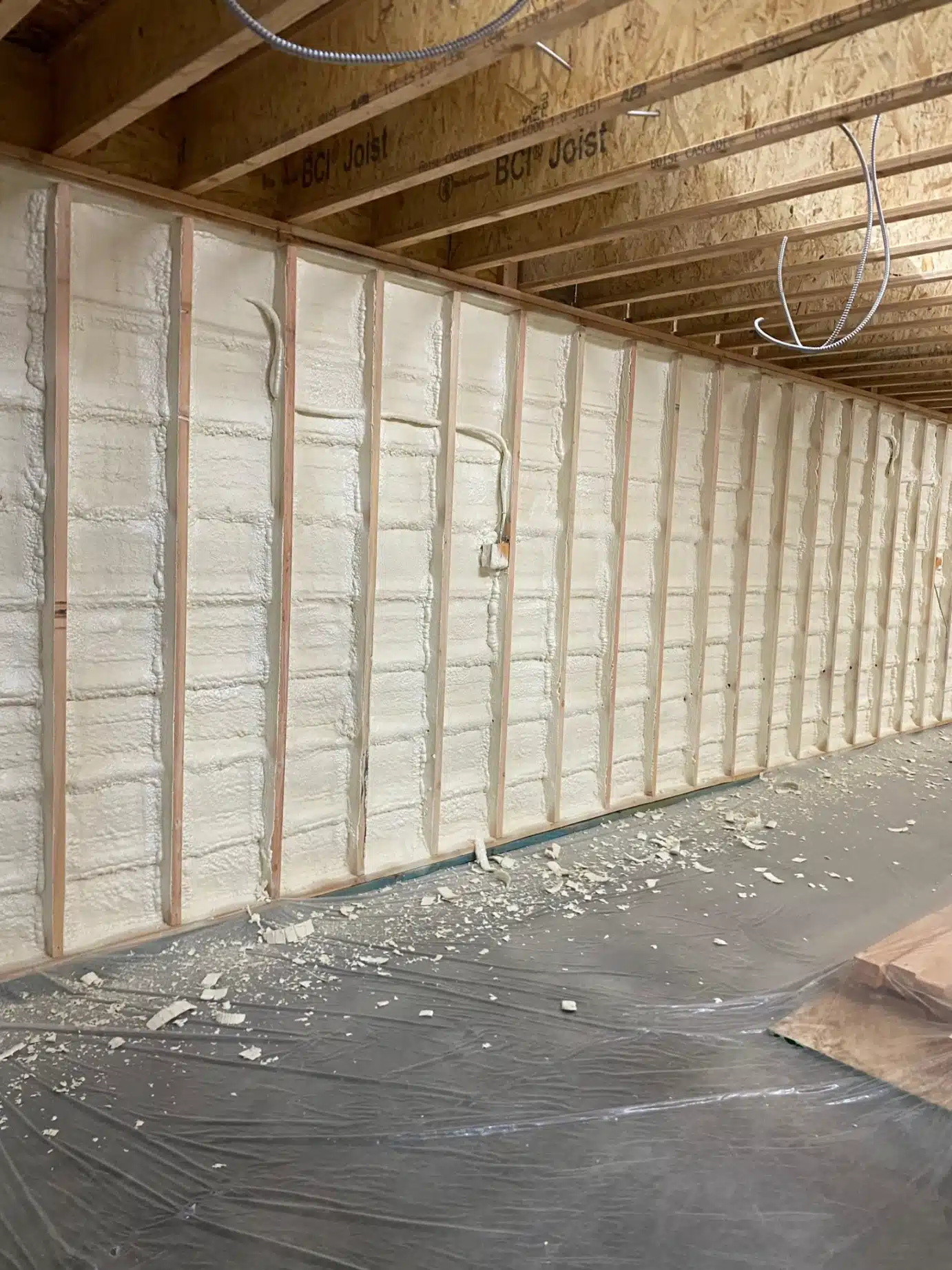
Builders in Bonners Ferry, ID operate in IECC Climate Zone 6, a cold-climate region where exterior walls must meet a minimum cavity insulation R-value of R-22 under the 2018 Idaho Energy Conservation Code. Open-cell spray foam has become a preferred choice for interior wall cavities in this market because it expands up to 150 times its original volume in a single pass, fills standard stud cavities completely in one application, and provides an air-impermeable barrier at typical thicknesses. For builders managing multiple projects or tight timelines across Boundary County, that speed of application translates directly into faster dry-in schedules, fewer callbacks, and easier coordination with other trades.
Open-cell spray foam insulation is a low-density polyurethane foam that cures into a soft, flexible matrix of interconnected cells. The chemistry behind open-cell foam uses water as the primary blowing agent, which drives its dramatic expansion ratio. According to the U.S. Department of Energy‘s Building America program, closed-cell foam expands roughly 35 to 50 times its liquid volume, while open-cell foam expands three times that amount, up to 150 times. That difference in expansion is what makes open-cell especially effective for filling irregular wall cavities, around electrical wiring, plumbing runs, and framing details in a single spray pass.
Once cured, open-cell foam weighs approximately 0.5 pounds per cubic foot and delivers an R-value of approximately R-3.6 per inch. In a typical 2×6 wall cavity with 5.5 inches of depth, that yields approximately R-20, which is meaningful in a Climate Zone 6 environment where the Idaho energy code requires R-22 cavity insulation for wood-frame exterior walls.
The air-sealing capability of open-cell foam is one of its primary advantages over conventional batt insulation. Both foam types are classified as air-impermeable at their typical installed thicknesses, which means they satisfy the continuous air barrier requirements of the energy code without requiring additional sealing materials. For builders, this eliminates an entire trade step (caulking and sealing around every framing member and penetration) and compresses the timeline.
The practical difference on a job site comes down to how quickly walls get insulated and sealed. With open-cell spray foam, an experienced crew can fill a standard 2×6 stud bay to full depth in a single pass. Closed-cell foam, by contrast, is typically limited to 2 to 3 inches of thickness per pass and requires multiple lifts to build up to the target R-value. More lifts mean more time on site, more material handling, and longer curing windows between passes.
For a builder in Bonners Ferry framing a 2,000 square foot home with standard exterior wall heights, the total exterior wall cavity area can exceed 1,000 square feet. Filling that area with open-cell foam at full cavity depth in one continuous pass keeps the insulation phase to a single day in many cases. The same walls with closed-cell foam might require two or three separate application visits.
The table below compares how the two foam types perform in wall cavity applications relevant to builders in cold climates:
| Property | Open-Cell Spray Foam | Closed-Cell Spray Foam |
|---|---|---|
| Density | 0.5 lb/ft³ | 2.0 lb/ft³ |
| R-value per inch | ~R-3.6 | ~R-6.1 |
| Expansion ratio | Up to 150x liquid volume | 35 to 50x liquid volume |
| Pass thickness | Full cavity depth (up to 10″) | 2 to 3 inches per pass |
| Air permeability | Air-impermeable at full thickness | Air-impermeable at typical thickness |
| Vapor permeance | ~5 to 10 perms (vapor permeable) | Less than 1 perm (vapor retarder) |
| Average per sq ft (wall cavity) | $0.60 | $2.45 |
| Best cold-climate wall use | Full cavity fill with interior vapor control | Hybrid flash-and-batt or full fill |
Bonners Ferry falls within IECC Climate Zone 6, one of the colder climate zones in the continental United States. The Idaho Energy Conservation Code, based on the 2018 IECC with state amendments, mandates specific minimum insulation values for residential construction. For wood-frame exterior walls in Climate Zone 6, the code requires either R-22 cavity insulation or a combination approach such as R-13 cavity insulation plus R-5 continuous insulation. The ceiling requirement in this zone is R-49, and the fenestration U-factor maximum is 0.30.
Open-cell spray foam installed to full 5.5 inch cavity depth provides approximately R-20. To meet the full R-22 prescriptive requirement, builders may need to either overspray slightly or combine the open-cell cavity fill with a continuous insulation product on the exterior. Alternatively, the performance compliance path (simulated energy modeling) often allows full open-cell fill to pass when other building envelope elements, such as high-performance windows and well-sealed air barriers, compensate for the marginal R-value difference.
Building Science Corporation notes that in Climate Zones 5 and higher, low-density open-cell spray foam can be used in wall cavities when paired with an interior vapor retarder to control condensation. This is an important detail for Bonners Ferry builders. Open-cell foam is vapor-permeable (5 to 10 perms at 5 inches), meaning interior moisture can potentially reach the foam and accumulate. Using a vapor-retardant paint on the interior drywall, or a dedicated vapor retarder primer, addresses this concern directly.
Choosing the right spray foam type depends on the building assembly and its exposure to moisture. The DOE Building America guide rates open-cell spray foam as “preferred” for frame-wall cavities in cold climates, “acceptable” for sloped roof rafters, and “not acceptable” for foundations, below-grade spaces, and HVAC duct insulation buried in attic insulation.
For Bonners Ferry builders, the practical breakdown is straightforward:
Interior wall cavities (exterior and partition): Open-cell foam is an efficient, fast-installing option. It fills cavities completely, seals air leaks, and delivers adequate R-value for the wall assembly. On interior partition walls, open-cell spray foam adds sound-dampening properties, which is a selling point for homeowners concerned with room-to-room noise. The DOE guide reports that open-cell foam in a 2×4 stud wall assembly achieves a Sound Transmission Class (STC) rating of 23 and a Noise Reduction Coefficient (NRC) of 70, meaning it absorbs a significant portion of airborne sound within the cavity.
Crawlspaces and foundations: Open-cell foam is not appropriate for these applications. The Building Science Corporation guide specifies that in IECC Climate Zones 5 and higher, only high-density closed-cell spray foam should be used on interior basement foundation walls and in vented crawlspaces. The moisture-permeable nature of open-cell foam makes it vulnerable to water absorption in these environments.
Roof assemblies: Open-cell foam is rated as “acceptable” for cathedral ceilings and unvented attics in cold climates, but Building Science Corporation recommends using only closed-cell foam in IECC Climate Zones 5 and higher for unvented conditioned attics. Builders should verify specific product Evaluation Service Reports before using open-cell foam in these assemblies.
Hybrid walls: A growing number of builders in cold climates use a hybrid approach, applying a thin layer (1.5 to 2 inches) of closed-cell foam against the exterior sheathing for its vapor-retarder and condensation-control properties, then filling the remaining cavity with open-cell foam. This approach meets code condensation control requirements while keeping material costs manageable.
The EPA‘s Safer Choice program provides detailed ventilation guidance for spray polyurethane foam applications, and these recommendations are directly relevant to builders scheduling interior wall insulation phases. During and immediately after spray application, vapors, mists, and particulates from trimming can linger in the work area. The EPA recommends establishing enclosures to isolate the work space, using fans to direct airflow across the spraying area, and directing filtered exhaust to a safe location outside the building. Other trades and occupants should not enter the space until the manufacturer’s re-occupancy procedures have been satisfied.
For builders in Bonners Ferry coordinating multiple trades on a single project, this means the spray foam phase needs to be scheduled as a distinct work window. HVAC installers, electricians, and finish carpenters should plan their work before or after the spray foam application and curing period. When the work area is properly ventilated and the foam has fully cured, re-entry is safe for all trades.
Working with a qualified spray foam installer makes the difference between a smooth project and one plagued by delays and callbacks. Here are the indicators that tell you a contractor knows what they are doing:
Selkirk Energy Solutions serves builders and homeowners throughout the Bonners Ferry area with professional open-cell and closed-cell spray foam insulation for new construction, retrofits, crawlspaces, attics, and commercial buildings. Our experienced team understands Idaho Climate Zone 6 requirements and will help you select the right insulation strategy for every assembly in your project.
Request a Free Quote | Schedule a Consultation
Call us at (208) 295-9780 or email [email protected] to discuss your next project. We will walk through your plans, recommend the right foam type for each building assembly, and provide a clear timeline so you can keep your build on track.
Full-cavity open-cell fill in a 2×6 wall delivers approximately R-20, which falls slightly short of the R-22 prescriptive requirement. Builders typically use the performance compliance path, add exterior continuous insulation, or slightly overspray to close the gap.
Open-cell foam has a Noise Reduction Coefficient of approximately 70 in a standard 2×4 stud wall assembly, meaning it absorbs most airborne sound within the cavity. It provides moderate sound transmission reduction and is effective for reducing room-to-room noise transmission.
Yes. Because open-cell foam is vapor-permeable (5 to 10 perms), an interior vapor retarder such as vapor-retardant primer or latex paint is recommended in cold climates to prevent moisture accumulation within the wall assembly.
Open-cell foam absorbs and holds liquid water, making it unsuitable for below-grade and crawlspace applications where moisture exposure is common. Closed-cell foam is the required choice for these assemblies in Climate Zones 5 and higher.
Re-occupancy times depend on the specific product formulation, ventilation rate, and environmental conditions. The EPA recommends following the manufacturer’s re-occupancy procedures and ensuring the area is fully ventilated before allowing workers or occupants back into the space.