How Can Spray Foam Insulation Help Reduce Persistent Drafts in Garwood, ID Homes?
Spray foam insulation reduces persistent drafts because it works as an insulation and an air barrier in a single application.…


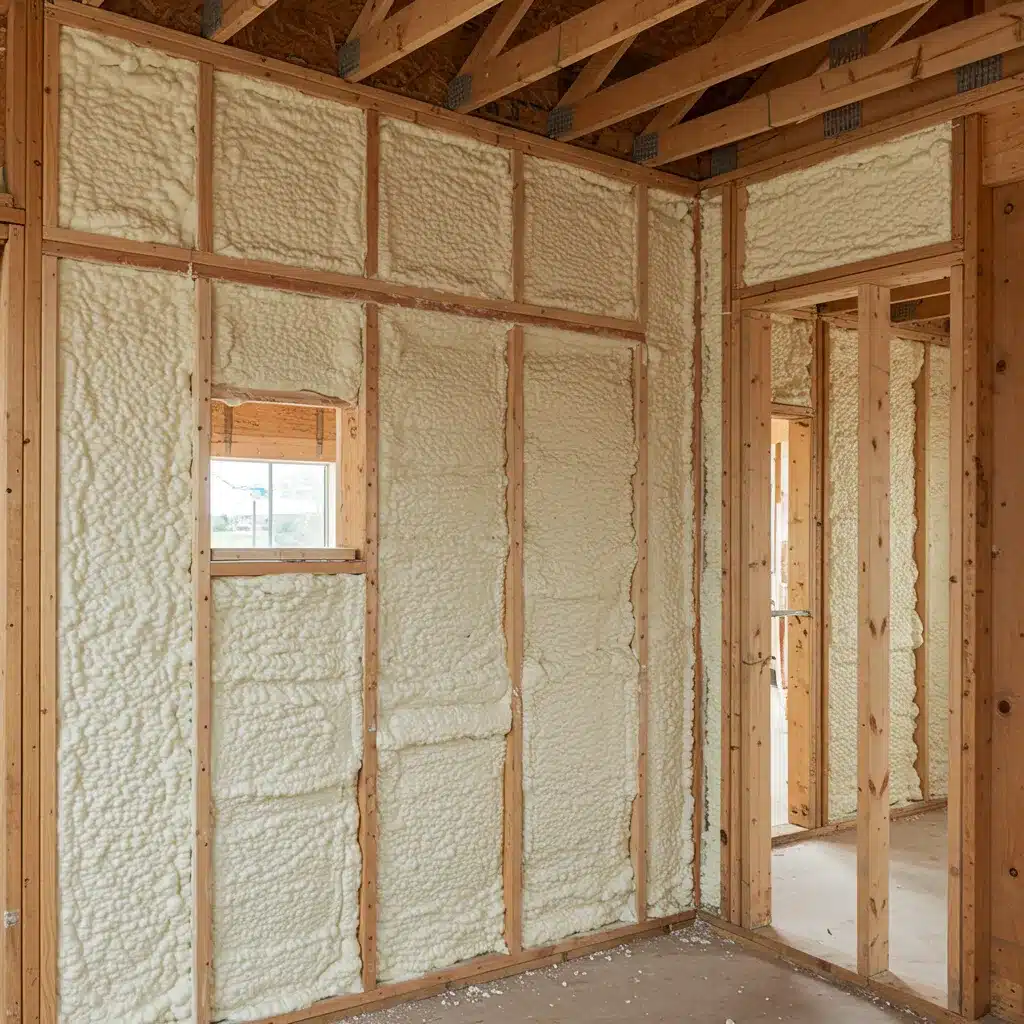
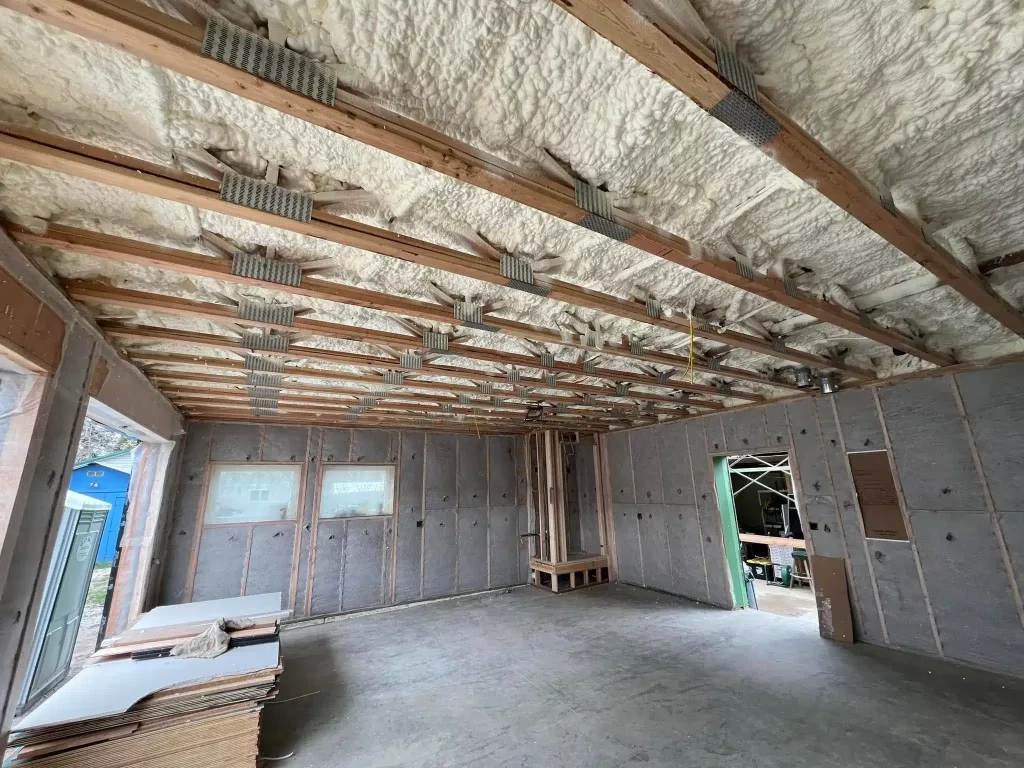
Open cell spray foam insulation is one of the most effective materials for air sealing in areas where traditional insulation like fiberglass batts or blown-in cellulose simply cannot reach or perform adequately. Its ability to expand into irregular cavities, fill gaps around framing, wiring, and plumbing penetrations, and adhere directly to substrates makes it a practical solution for hard-to-insulate spaces such as crawlspaces, cathedral ceilings, rim joists, and complex roof assemblies. The Complete Guide to Open Cell Spray Foam Insulation provides further insight into how this material can be used in these challenging areas. The right approach depends on the specific space, climate zone, and whether the project involves new construction or a retrofit. Below, we break down how open cell spray foam works for air sealing, where it performs best, and what to consider before making a decision.
Open cell spray foam is a low-density polyurethane foam produced by mixing polyols and isocyanates on-site and spraying the mixture onto surfaces where it expands and cures into a solid cellular material Polyurethane foam – Wikipedia. Unlike closed-cell foam, open cell foam has interconnected pores that give it a softer, more flexible texture. This structure is what gives open cell foam its air sealing characteristics: as the material expands during application, it flows into and seals cracks, gaps, and voids that would otherwise remain untreated with batt or loose-fill insulation.
The R-value of open cell polyurethane spray foam is approximately R-3.6 per inch R-value (insulation) – Wikipedia. While this is lower per inch than closed-cell spray foam (R-5.5 to R-6.5 per inch) or rigid foam boards, the real advantage lies in how the material is applied. It is sprayed as a liquid that expands many times its original volume, conforming to the exact shape of the cavity. This means it seals around obstructions like electrical wires, plumbing runs, ductwork, and irregular framing that would create gaps and air pathways with conventional insulation.
Building insulation works by slowing conductive, convective, and radiative heat transfer through the building envelope Building insulation – Wikipedia. However, insulation alone cannot stop air leakage. As noted in the R-value article, “insulation installed between wall studs may reduce, but usually does not eliminate, heat losses due to air leakage through the building envelope” R-value (insulation) – Wikipedia. Spray foam addresses both thermal resistance and air leakage simultaneously, which is why it performs well in spaces where both properties matter.
Not every insulation challenge calls for the same material. Open cell spray foam is particularly well-suited to specific types of hard-to-insulate spaces.
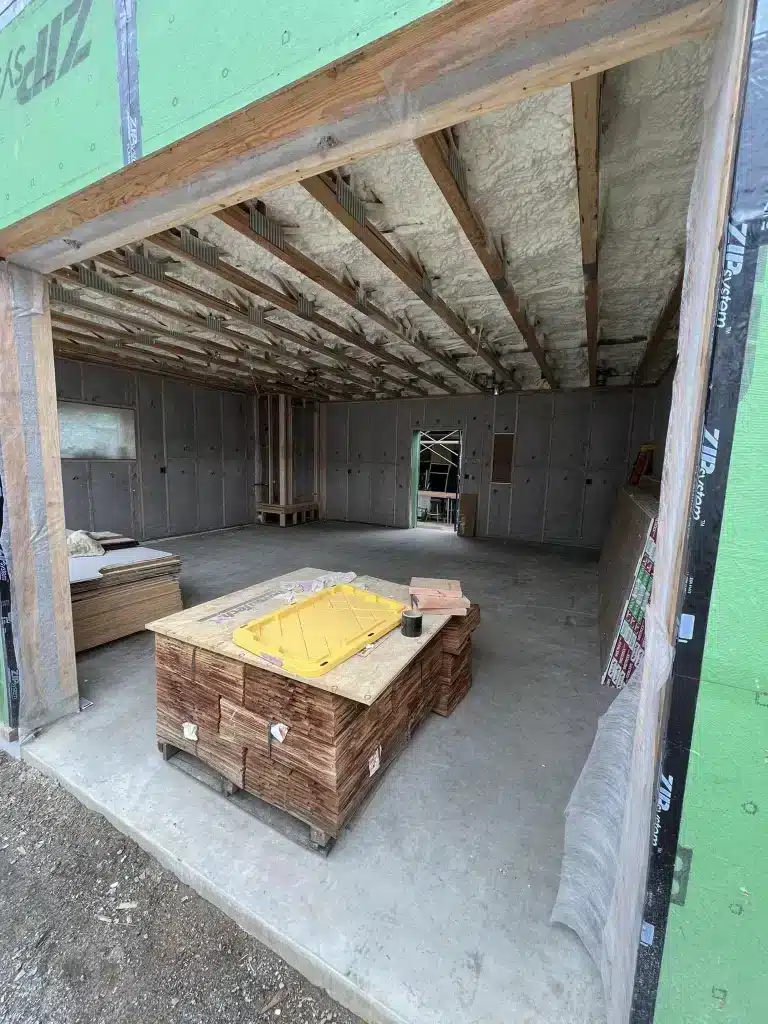
Crawlspaces are among the most common problem areas in residential energy performance. They are often difficult to access, have uneven surfaces, and contain numerous penetrations for plumbing, electrical, and HVAC runs. Open cell spray foam can be applied directly to the crawlspace walls and floor joists, sealing around every penetration and filling voids in the rim joist area where air infiltration is typically highest.
Cathedral ceilings with limited rafter depth present a challenge because there is often not enough cavity space to achieve code-required R-values with fiberglass batts alone. Open cell spray foam service can fill the entire rafter bay from top to bottom, providing both the air barrier and the insulating layer in a single application. Its flexibility also accommodates the natural movement of roof structures without cracking or losing its seal.
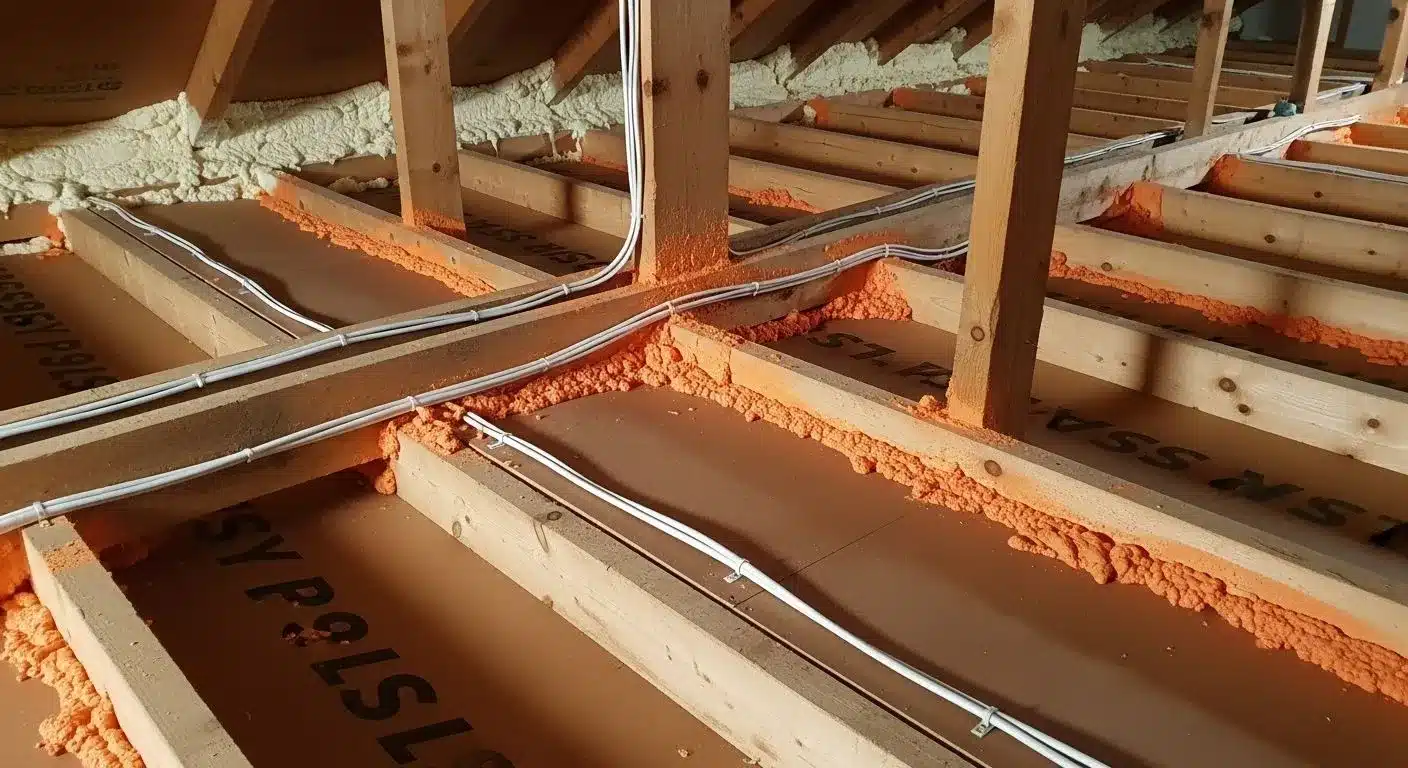
In attics with trusses, ductwork, lighting fixtures, and multiple penetrations, laying batt insulation or blowing loose-fill material inevitably leaves air pathways open. Open cell spray foam seals around all of these obstructions, creating a continuous barrier on the attic floor that dramatically reduces air exchange between conditioned and unconditioned spaces.
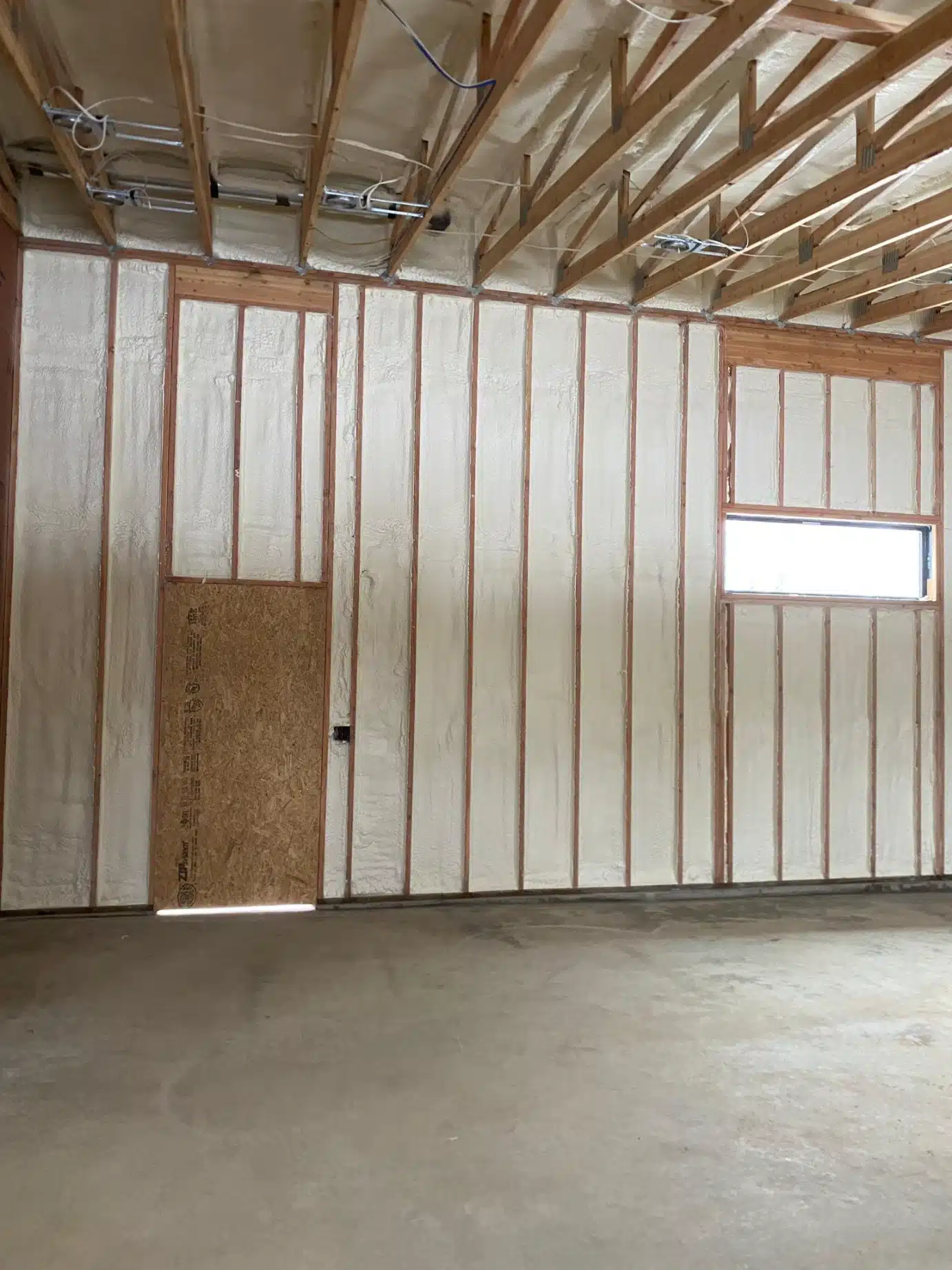
Weatherization practices emphasize sealing bypasses, especially around doors, windows, pipes, and wiring that penetrate ceilings and floors Weatherization – Wikipedia. Open cell spray foam is an efficient way to address these penetration points in a single pass, particularly during new construction or major renovations where wall and ceiling cavities are still accessible.
The choice between open cell and closed cell spray foam depends on the specific requirements of the space. Here is how they compare for air sealing applications.
| Feature | Open Cell Spray Foam | Closed Cell Spray Foam |
|---|---|---|
| R-value per inch | ~R-3.6 | ~R-5.5 to R-6.5 |
| Air sealing capability | Excellent, fills all gaps | Excellent, fills all gaps |
| Vapor permeability | Vapor-permeable (allows drying) | Acts as a vapor barrier |
| Density | Low (~0.5 lb/ft3) | High (~2.0 lb/ft3) |
| Best application | Wall cavities, attics, crawlspaces | Below-grade, rim joists, metal buildings |
| Expansion | Expands significantly (100x) | Expands moderately (30-40x) |
Open cell foam’s vapor permeability is an advantage in many above-grade wall and ceiling assemblies because it allows any trapped moisture to dry through the foam rather than being trapped against the building materials. Closed cell foam, while offering higher R-value per inch and a built-in vapor barrier, can trap moisture if not properly detailed with the rest of the building assembly.
Air sealing is fundamentally about reducing unwanted convective heat flow. Weatherization, which is distinct from insulation, primarily targets this convective heat loss by sealing cracks, gaps, and holes in the building envelope Weatherization – Wikipedia. When a building is not properly air sealed, conditioned air escapes through penetrations, framing gaps, and poorly fitted components, and unconditioned air enters to replace it. This forces HVAC systems to work harder to maintain indoor temperatures.
According to ENERGY STAR, sealing and insulating is often the most cost-effective way to improve a home’s energy efficiency and comfort ENERGY STAR – Air Seal & Insulate. The program emphasizes that identifying and sealing air leaks should happen before or alongside adding insulation, because insulation without air sealing will not deliver its rated thermal performance.
Thermal bridges, which are points in the building envelope where heat flows more easily through continuous conductive paths like studs or unsealed penetrations, further reduce effective insulation performance Building insulation – Wikipedia. Spray foam interrupts these thermal bridges by filling around framing members and sealing the gaps where air would otherwise move through the assembly.
| Project Type | Recommended Approach | Key Considerations |
|---|---|---|
| New construction walls | Open cell spray foam in wall cavities | Pair with appropriate exterior sheathing; vapor-permeable nature works well with standard drywall |
| Crawlspace encapsulation | Open cell spray foam on walls and rim joist | Ensure ground moisture is managed first; verify crawlspace height for equipment access |
| **Attic retrofit (floor) | Open cell spray foam on attic floor | Addresses complex framing and penetrations; requires ventilation strategy for remaining attic space |
| Basement rim joist | Closed cell spray foam recommended | Below-grade contact and higher moisture risk favor closed cell’s vapor barrier properties |
| Cathedral ceiling | Open cell spray foam in rafter bays | Verify total R-value meets code for climate zone; may need thicker application |
Choosing the right team for a spray foam installation is just as important as choosing the right material. Here are indicators that you are working with a qualified professional:
Selkirk Energy Solutions specializes in open cell and closed cell spray foam insulation for residential and commercial projects throughout the 83864 area and surrounding region. Our team evaluates each space individually to recommend the right insulation strategy for your specific building, whether that is a crawlspace encapsulation, attic retrofit, or new construction wall assembly. Contact us at [email protected] or call (208) 295-9780 to discuss your project.
Request a Quote | Schedule an Assessment
It can be used in above-grade basement walls, but below-grade or rim joist areas typically call for closed cell foam due to higher moisture exposure and the need for a vapor barrier.
The required thickness depends on your climate zone and the target R-value for the assembly. Our team calculates the correct depth based on local code requirements and the specific application.
Open cell foam is vapor-permeable, so in most above-grade wall and ceiling assemblies, standard drywall provides adequate vapor retardation. The specific assembly details determine whether additional vapor control is needed.
Open cell spray foam expands and cures within minutes of application, but full off-gassing may take 24 to 72 hours depending on temperature, humidity, and ventilation conditions.
Flexible polyurethane foams with open pore structures are widely recognized as effective noise absorption materials, making open cell spray foam a practical choice where both thermal and acoustic performance are needed.