How Can Spray Foam Insulation Help Reduce Persistent Drafts in Garwood, ID Homes?
Spray foam insulation reduces persistent drafts because it works as an insulation and an air barrier in a single application.…


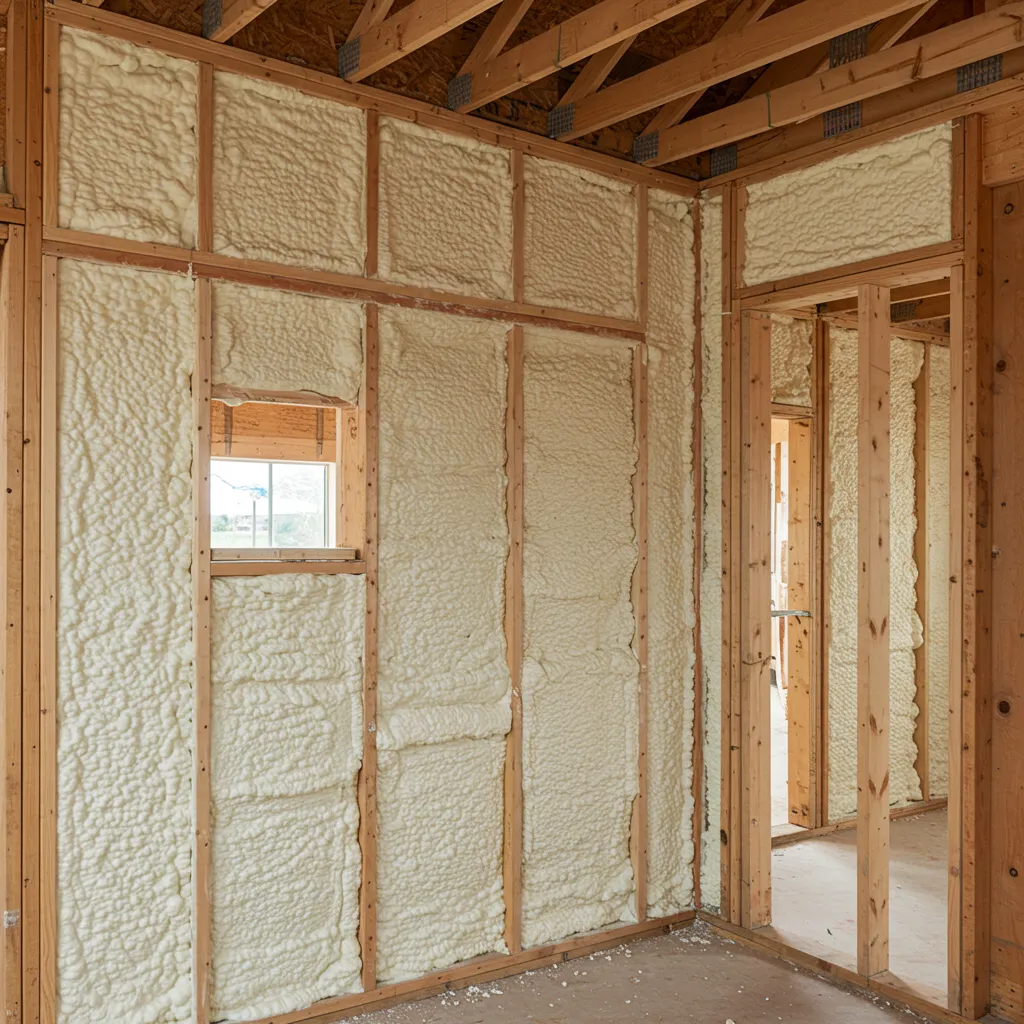
Moisture and material price are two of the most impactful variables that can push open-cell spray foam pricing well above its baseline range. According to our pricing data, open cell spray foam typically ranges from $0.45 to $0.75 per square foot, but jobsite moisture problems and volatile raw material costs can drive that number toward the higher end or even beyond it. Open cell spray foam is vapor permeable, meaning it absorbs and holds liquid water, and its chemical components, primarily polyols and isocyanates derived from crude oil, fluctuate with petroleum markets. When either factor enters the equation, contractors must invest more time, labor, and additional materials to deliver a quality installation, and those costs get passed directly into the project price.
Open-cell spray foam, sometimes called half-pound foam, has an interconnected cell structure that makes it effective at air sealing but poor at resisting moisture. According to the U.S. Department of Energy’s Building America spray foam guide, open-cell SPF at a typical thickness of 5 inches is rated at 5 to 10 perms, well above the 1.0 perm threshold that defines a vapor retarder. The same guide notes that open-cell foam “will also absorb and hold liquid water,” up to one-third of its volume in some cases.
This means that when we encounter a wet or damp jobsite, whether it is a crawlspace with groundwater seepage, an attic with roof leaks, or framing that has been exposed to rain during construction, we cannot simply spray over it. The foam would bond poorly to wet substrates, and trapped moisture behind the foam could lead to mold growth, wood rot, and complete failure of the insulation system.
Every moisture-related problem on a jobsite triggers a chain of additional work that increases pricing:
| Moisture Issue | Required Additional Work | Cost Impact |
|---|---|---|
| Wet substrate (above 19% MC) | Dehumidifiers, fans, and wait time for drying | Extended schedule, equipment rental |
| High ambient humidity (near dewpoint) | Climate control, rescheduling | Labor delays, potential overtime |
| Crawlspace moisture | Vapor barrier installation, drainage correction | Additional materials and labor |
| Existing mold or water damage | Remediation before insulation | Significant additional scope |
| Cold climate vapor drive | Vapor retarder coating over cured foam | Extra material, additional pass |
The Building Science Corporation residential spray foam guide emphasizes that wherever unvented conditioned attics are constructed with spray foam, a means of moisture removal from the space is necessary. This is not optional. It is a code and building science requirement that directly affects project pricing.
In colder regions, specifically IECC Climate Zones 5, 6, 7, and 8, the building code requires that open-cell spray foam be coated with a Class II vapor retarder when used in unvented roof assemblies. The Pacific Northwest National Laboratory Building America Solution Center confirms that open-cell foam should have a vapor retarder applied in these cold climates, adding another material and labor step to every project.
Our service area around Sandpoint, Idaho, falls into a cold climate zone, so this is a cost factor we account for on virtually every open-cell spray foam project.
Spray polyurethane foam is manufactured on-site from two chemical components. Side A contains isocyanates, and Side B contains polyol resins, catalysts, flame retardants, and blowing agents. According to the U.S. Department of Energy’s Insulation Materials guide, low-density open-cell polyurethane foams use water or carbon dioxide as the blowing agent, which keeps material costs lower than closed-cell foam that uses hydrofluoroolefin blowing agents. However, both sides of the chemistry are derived from petroleum feedstocks.
When crude oil prices spike, the cost of isocyanates and polyols rises accordingly. This is not a gradual change. Material prices can shift significantly between the time a project is quoted and the date of installation, sometimes within a matter of weeks.
Construction cost data from Gordian’s RSMeans insulation cost tracking shows that insulation material costs have experienced three straight quarters of double-digit year-over-year growth, with fiberglass insulation costs rising 18.49% since Q2 of 2025. While this data tracks fiberglass specifically, spray foam chemicals follow similar petroleum-driven price trends. When the raw materials for foam become more expensive, the per-square-foot price for installed open-cell foam increases as well.
Our pricing sheet identifies material price changes as one of the factors that increase our open-cell spray foam pricing. When chemical suppliers raise prices, we must adjust our per square foot rates to cover the difference. This is why our open-cell spray foam ranges from $0.45 per square foot on the low end to $0.75 per square foot on the high end, with the actual price depending heavily on current material costs and site conditions at the time of the project, as explained in open-cell spray foam solutions guide.
| Project Type | Location | Size | Key Challenge | Price Impact |
|---|---|---|---|---|
| New construction, walls | Sandpoint, ID area | 2,000 sq ft | Clean, dry, easy access | Low end of the range |
| Retrofit attic insulation | Rural North Idaho | 1,800 sq ft | Tight access, old insulation removal | Mid to high range |
| Crawlspace insulation | Sandpoint, ID area | 1,200 sq ft | Moisture issues, low clearance | High end of the range |
| Commercial building | North Idaho | 3,500 sq ft | Large scope but difficult access | Mid range |
| Wall retrofit, older home | Sandpoint, ID area | 2,500 sq ft | High humidity, vapor retarder required | High end of the range |
| Factor | How It Affects Price | Typical Impact |
|---|---|---|
| Access to the work area | Tight crawlspaces, steep attics, and obstructed walls slow production | Largest single factor |
| Moisture or mold issues | Requires drying, remediation, and vapor barriers before spraying | Significant increase |
| Material price changes | Petroleum market volatility changes chemical costs | Moderate to significant |
| Travel distance | Remote job sites add fuel, time, and mobilization cost | Moderate increase |
| Climate zone requirements | Cold zones need vapor retarder coatings | Moderate increase |
| Job site cleanliness | Clean, prepared sites reduce labor time | Can lower pricing |
| Project size | Larger projects may offer some economies of scale | Can lower per sq ft cost |
| Thickness requirements | Deeper applications require more material | Direct material cost increase |
The real question is not whether moisture management and material quality add cost to your open-cell spray foam project. The real question is what happens to your building when they are skipped. Spray foam applied over a wet substrate bonds poorly and can trap moisture against wood framing, leading to decay that may not become visible for years. Open cell foam installed without a required vapor retarder in a cold climate can allow condensation to accumulate inside wall and roof assemblies, eventually causing mold growth and structural damage, which is why proper understanding of open-cell spray foam advantages is essential when comparing insulation systems.
The cost of ripping out failed insulation, remediating mold, repairing structural damage, and then re-insulating correctly is many times the cost of doing the job right the first time. When we account for moisture conditions and use quality materials at current market prices, we are protecting your investment in the building, not just adding line items to a quote.
Our team at Selkirk Energy Solutions has extensive experience diagnosing moisture conditions and accounting for material price variables on every open-cell spray foaml project we take on in the Sandpoint, Idaho area and throughout North Idaho. We evaluate your jobsite conditions, factor in current material costs, and give you honest pricing that reflects what it actually takes to install spray foam that performs for the life of your building. Contact us at [email protected] or call (208) 295-9780 to get started.
Request a Quote Schedule a Site Assessment
We would rather give you an accurate price upfront than a low estimate that surprises you later.
Yes. Wet or humid jobsites require drying time, dehumidification equipment, and sometimes vapor barrier installation before we can spray. All of that preparation adds labor and equipment costs to the project.
Spray foam chemicals are petroleum-derived. When crude oil and natural gas prices fluctuate, the cost of isocyanates, polyols, and blowing agents changes accordingly. We adjust our pricing to reflect current material costs at the time of your project.
In most cases, yes. Our area falls into a cold climate zone where building codes require a Class II vapor retarder over open-cell foam in unvented roof and wall assemblies. This adds a material and labor step to the project.
No. The substrate must be below 19% moisture content for proper adhesion. We always measure moisture levels before spraying, and if the surface is too wet, we work with you to get it dried before application begins.
Access to the work area is our largest pricing factor. Tight crawlspaces, steep attics, and hard-to-reach spaces slow down production significantly. Moisture issues and material price changes are the next two biggest drivers of higher pricing.